
Why the Boeing 747-8 Still Works for Lufthansa


By Julio Ramirez
Senior Analyst
Published: 1 October 2026
The Boeing 747 has largely disappeared from scheduled passenger operations as airlines have shifted towards smaller and more fuel-efficient twin-engine widebodies. Lufthansa remains one of the most prominent exceptions, having operated successive generations of the 747 for more than five decades. This long-standing relationship with the aircraft has also allowed the Lufthansa Group to develop extensive technical and maintenance expertise through Lufthansa Technik, providing an established support ecosystem for the type. As part of its ongoing fleet modernisation, the Lufthansa Group plans to retire several older long-haul aircraft types, including the 747-400 and A340-300 by 2027, following the retirement of the A340-600 in 2026, with other legacy widebody types also being phased out across the Group. Yet the 747-8 will remain part of Lufthansa Group's planned widebody fleet through 2030. This makes its continued role particularly notable and raises the question of how economically efficient the aircraft actually is for the airline.
Using RDC Aviation's Route Performance tool, this article examines five routes operated exclusively with the 747-8 by Lufthansa in 2026 and compares their current operation with the A350-900 as a next-generation widebody alternative. Rather than simply comparing both aircraft at the same frequency, the analysis considers the capacity and frequencies required to accommodate the same level of passenger demand, allowing the cost and profitability implications of replacing the 747-8 with a smaller aircraft to be assessed.
The analysis therefore explores whether the 747-8's higher capacity can compensate for the greater operating efficiency of the A350-900, and whether the need for additional frequencies with a smaller aircraft helps explain why the Jumbo continues to have a role in Lufthansa's long-haul network.
The Boeing 747 in 2026
Chart 1, shows that Lufthansa is by far the largest remaining provider of scheduled passenger 747 capacity, accounting for 68.6% of the global seat supply in 2026. Its position is even stronger for the 747-8, where it provides 70.8% of scheduled capacity, well ahead of the other remaining operators.
The 747-8 now accounts for 64.1% of all scheduled passenger 747 seats, showing that the latest version of the 747 has become the backbone of the aircraft's remaining passenger operation. Lufthansa's scale is particularly significant, with its 2.6 million scheduled 747-8 seats alone exceeding the total 747 capacity offered by all other operators combined.
Across the 20 Frankfurt routes where Lufthansa deploys a Boeing 747 in 2026, the aircraft provides 3.92 million of the 5.39 million scheduled seats, accounting for almost 73% of capacity across these markets. Across Lufthansa's wider Frankfurt widebody network, the 747 fleet represents around 38% of total widebody seat capacity, with the 747-8 alone accounting for 25%. Its deployment is particularly concentrated on Buenos Aires, São Paulo, Tokyo Haneda, Johannesburg and Mexico City, which are operated exclusively by the 747-8 as shown in Chart 2, with daily year-round services and together account for 51% of its total capacity. This concentration on high-capacity markets may help explain the aircraft's continued role, as replacing it with smaller widebodies could result in spilled demand or require additional frequencies, which may be difficult to accommodate given slot constraints at Frankfurt.
Lufthansa 747-8 vs A350-900
The A350-900 is selected as the next-generation widebody alternative to the 747-8, reflecting its growing role within Lufthansa's long-haul fleet and the wider transition towards more fuel-efficient twin-engine aircraft. All five routes operated exclusively by the 747-8 are served seven times per week, therefore, based on the current 747-8 capacity and an 85% load factor, broadly aligned with Lufthansa's reported international performance, this represents annual demand of over 225,000 passengers. As Table 1 shows, operating the same seven weekly frequencies with the lower-capacity A350-900 would accommodate a maximum of 213,890 passengers, resulting in 11,972 spilled passengers. The A350 scenario is therefore increased to eight weekly frequencies, allowing it to accommodate the same market demand at approximately 92% load factor, enabling the comparison to assess the cost of serving the same level of passenger demand while accounting for the additional frequency required by the A350-900.
Chart 3 shows a clear cost advantage for the A350-900 across all five markets. Despite operating eight weekly frequencies compared with seven for the 747-8, the A350 reduces total annual operating costs by approximately 14–15% on every route analysed. The largest absolute saving is observed on Buenos Aires, where annual costs fall from €148.7 million to €127.8 million, a reduction of almost €21 million. Savings of approximately €17–18 million per year are also achieved across São Paulo, Johannesburg, Mexico City and Tokyo Haneda.
Importantly as Chart 4 shows, the lower operating costs translate into substantially stronger profitability rather than simply lower aircraft costs. The estimated profit margin improves across every route, increasing by between 8.9 and 15.4 percentage points under the A350 scenario, using the average fare observed on each route over the last 12 months. The largest improvement is observed on Johannesburg, where the margin increases from just 3.0% with the 747-8 to 18.4% with the A350-900. São Paulo increases from 18.4% to 31.2%, Mexico City from 14.4% to 27.3%, and Buenos Aires from 19.3% to 31.5%.
Tokyo Haneda stands out as the strongest-performing market under both scenarios. The route already generates an estimated 40.8% margin with the 747-8, supported by the highest average fare among the five markets at approximately €881, yet the A350 still increases the estimated margin to 49.7%.
Taken together, the results suggest that the 747-8's capacity advantage is not sufficient on its own to offset the operating efficiency of the A350-900. Even after introducing an additional weekly A350 frequency to accommodate approximately the same passenger demand, the newer twin-engine aircraft remains around 14–15% cheaper to operate annually and produces a higher estimated profit margin on every route analysed.
This does not necessarily mean that replacing the 747-8 is straightforward. The analysis assumes that Lufthansa can provide the additional A350 frequency required to maintain capacity, whereas in practice this would depend on aircraft availability, scheduling and, importantly, slot availability. As Chart 5 shows, five of the six airports involved in the routes analysed are Level 3 coordinated airports, including Frankfurt and four of the five destinations. Under the IATA Worldwide Airport Slot Guidelines, Level 3 applies where demand for airport infrastructure significantly exceeds available capacity and airlines require an allocated slot to operate during coordinated periods. This means that introducing the additional frequencies required by a smaller aircraft may not always be straightforward. The 747-8 therefore retains an important operational advantage by concentrating a large volume of demand into fewer frequencies.
Conclusion:
The analysis shows that the A350-900 delivers stronger operating economics than the 747-8, with annual costs around 14–15% lower and higher estimated profit margins across all five routes, even when an additional weekly frequency is required. However, aircraft economics alone do not determine fleet deployment. Lufthansa benefits from an established technical and maintenance ecosystem through Lufthansa Technik, with extensive experience supporting the 747-8 and its GEnx-2B engines, which may help reduce some of the complexity associated with continuing to operate the type. More importantly, the 747-8 allows Lufthansa to concentrate substantial passenger demand into fewer frequencies, an important advantage given that Frankfurt and four of the five destinations analysed are Level 3 coordinated airports, where additional slots may be difficult to secure.
The continued role of the 747-8 therefore appears to be driven less by it being the most economically efficient aircraft and more by its network utility. Its combination of high capacity, established technical support and the ability to serve high-demand markets without requiring additional frequencies helps explain why the aircraft can still work for Lufthansa. As more next-generation widebodies enter the fleet, the economic case for the 747-8 may gradually weaken, but while capacity and slot constraints remain important, the Jumbo continues to provide Lufthansa with an operational capability that smaller widebodies cannot always replicate as efficiently within the existing schedule.
Chart 1. Passenger Seat Supply of B-747 (2026)
Source: RDC Apex
Chart 2. Lufthansa B-747 Route Capacity vs Other Widebodies (2026)
Source: RDC Apex
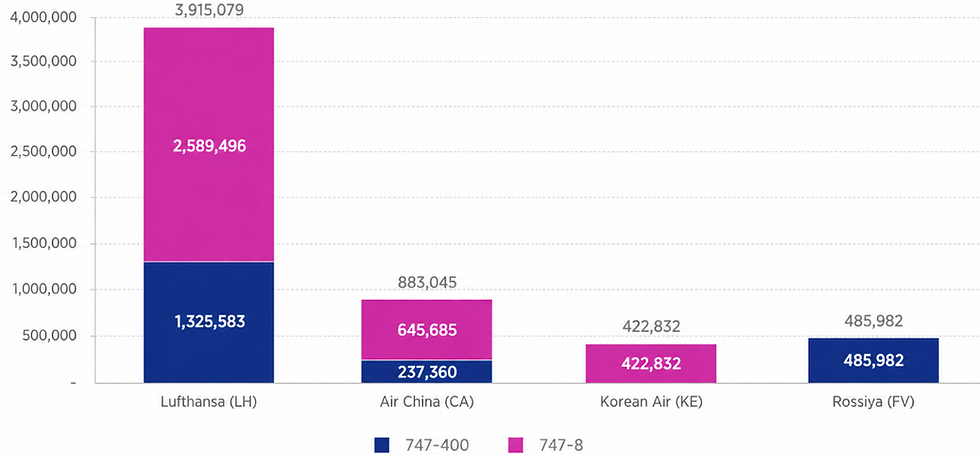

Table 1. Aircraft Capacity and Frequency Comparison
Source: RDC Apex


Chart 3. Annual Operating Cost of B747-8 vs A350-900
Source: RDC Apex

Chart 4. Estimated Profit Margin and Average Fare
Source: RDC Apex
Chart 5. Slot Coordination Across Lufthansa 747-8 Airports

Source: IATA/WASG