
Why Castlelake Wants to Buy easyJet: Looking Beyond the Headlines

Photo by Winston Tjia on Unsplash

By Julio Ramirez
Senior Analyst
Published: 1 July 2026
Much has been discussed in recent days about the interest shown by Castlelake, the US-based investment firm specialising in aviation, in acquiring easyJet. The firm's approach follows a period during which many investors believed easyJet's share price did not fully reflect the company's true value. However, beyond its market valuation, easyJet possesses several strategic assets that make it an attractive acquisition target.
One of easyJet's most valuable assets is its portfolio of slots at some of Europe's most capacity-constrained airports. In its 2025 Annual Report, the airline reinforces that "access to slot-constrained airports is a core strategic asset rather than simply an operational requirement", highlighting that these airports offer superior demand and yield characteristics. Combined with one of the world's largest Airbus A320 family fleets, comprising 356 Airbus A320 family aircraft as at 30 September 2025 and an average fleet age of 10.4 years, these strategic assets further strengthen easyJet's competitive position and help explain why the airline has attracted significant investor interest.
To better understand easyJet's long-term value, it is equally important to assess the airline's current operational performance. This article therefore examines easyJet's network recovery since COVID-19, the structure of its operating bases and the distribution of capacity across its network, with particular emphasis on its presence at slot-constrained airports. The second part of the analysis explores the profitability of easyJet's route network, identifying its most profitable airports to provide a better understanding of the airline's financial performance and long-term value.
Network
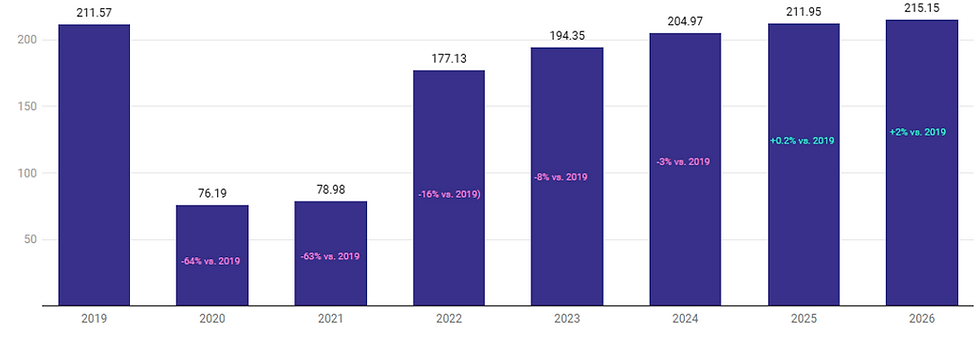
Chart 1 shows easyJet did not return to its 2019 seat capacity until 2025, when it slightly exceeded pre-pandemic levels by 0.2%, and it is expected to operate 2% above 2019 levels in 2026. The recovery gained significant momentum from 2022 onwards, when seat capacity reached 84% of 2019 levels, representing a 16% shortfall compared with the pre-pandemic benchmark. Capacity in 2020 and 2021 remained severely affected, with the airline operating less than 40% of its 2019 capacity in both years. The strongest year-on-year recovery occurred in 2022, when seat capacity increased by 124% compared with 2021.
Chart 1 easyJet Annual Seat Capacity (Millions), 2019-2026
Source: RDC Apex Created with Datawrapper
At an airport level, easyJet is scheduled to operate flights from 164 airports across its network in 2026, with the top 50 airports accounting for 84% of the airline's total seat capacity. Operating under three Air Operator Certificates (AOCs)—easyJet UK, easyJet Europe and easyJet Switzerland—easyJet will have 33 operational bases by the end of 2026 across nine countries in the UK, mainland Europe and, for the first time, Africa, following the opening of its new base in Marrakesh under the easyJet Europe AOC. These bases account for 73% of the airline's total seat capacity, and all are ranked within the top 50 airports by capacity.
Breaking this down by AOC, easyJet Europe bases account for 35% of total seat capacity, followed by easyJet UK with 31% and easyJet Switzerland with 7%. Among all operational bases, London Gatwick (LGW) remains easyJet's largest, accounting for 10% of the airline's total seat capacity. LGW offers 56% more capacity than Geneva (GVA) and 60% more than Milan Malpensa (MXP), which are the second- and third-largest operational bases and the largest within the easyJet Switzerland and easyJet Europe AOCs, respectively.
From a country perspective, the UK has the largest concentration of seat capacity, accounting for 31% of total capacity across 11 operational bases, including the recently opened bases at Newcastle (NCL) and London Southend (SEN). France (11%) and Italy (8%) represent the airline's next largest markets, while Switzerland contributes a further 7%. Spain and Portugal together account for 9% of total seat capacity, although four of their seven bases operate seasonally. The remaining bases are located in the Netherlands (3%), Germany (2%) and, from 2026, Morocco (1%).
Chart 2 Top 50 easyJet Airports by Seat Capacity, 2026

Source: RDC Apex Created with Datawrapper
Chart 3 shows that among easyJet's top 50 airports, thirty four are IATA Level 3 coordinated airports, twelve are Level 2 airports, and only three are Level 1 non-coordinated airports. In total, easyJet allocates 65% of its 2026 seat capacity to Level 3 coordinated airports, while its 33 operational bases across the airline's three Air Operator Certificates account for 57% of the seat capacity operated at Level 3 airports.
Moreover, across all IATA Level 3 coordinated airports, easyJet holds an average 16% share of total seat capacity, rising to 30% across UK Level 3 airports, reflecting the airline's particularly strong position in its home market. The airline holds its highest capacity shares at Bristol (56%), London Gatwick (44%) and London Luton (38%), ranking first, second and fourth, respectively, among all level 3 airports in its network. Together, these figures reinforce easyJet's strategy of prioritising slot-constrained airports, supporting the company's view that access to these airports is a core strategic asset and one of its key competitive advantages.
Chart 3 Seat Capacity Share of easyJet's Top 50 Airports, 2026

Source: IATA, RDC Apex Created with Datawrapper
Profitability
easyJet reported another strong financial performance in 2025, with revenue exceeding £10 billion for the first time and net profit increasing to £494 million, driven by continued growth in passenger numbers and improved operational performance. According to the airline's 2025 Annual Report, easyJet carried 93.4 million passengers during the year while maintaining a network-wide load factor of 89.8%, demonstrating the overall profitability and resilience of its network.
At airport level, only 25 of easyJet's 164 airports are estimated to report an average operating loss across their routes as shown in Chart 4. Lampedusa records the highest estimated profit margin at 58%. However, in 2025 easyJet operated only two seasonal routes from the airport—to Milan Malpensa and Naples. This summer-only operation is likely to explain its exceptionally high profitability, as seasonal routes are able to capture peak leisure demand and higher average fares while avoiding the weaker winter months.
This pattern is consistent across the airline's ten most profitable airports. All are served exclusively by seasonal routes, with operations typically ending before the start of the winter season or, in some cases, extending only until December. By avoiding January and February, when average fares are generally at their lowest, these routes achieve significantly stronger profit margins than year-round operations.
Conversely, the lowest-performing airports are predominantly those served by year-round or winter seasonal routes. Unlike summer seasonal services, these operations continue during periods of weaker demand, when lower average fares place significant pressure on profitability. This further highlights the importance of summer seasonal routes in shaping the financial performance of easyJet's network.
A similar trend can be observed when analysing operational bases. Faro, Palma de Mallorca and Alicante—all seasonal bases—rank first, third and fourth, respectively, among easyJet's operational bases by estimated profit margin. This further highlights the strong influence of seasonality on financial performance.
By contrast, some of easyJet's largest bases, including London Gatwick, Geneva and Milan Malpensa—the largest bases within each of the airline's three Air Operator Certificates (AOCs)—generate lower profit margins than several smaller bases. This is likely to reflect the higher operating costs associated with major airports, including higher airport charges and potentially greater fuel consumption resulting from longer taxi times and increased air traffic congestion. In addition, these bases operate a much larger proportion of year-round routes, which is also likely to contribute to their lower profitability compared with predominantly seasonal bases. Nevertheless, these strategic bases remain profitable overall, with estimated profit margins of 15% at London Gatwick, 14% at Geneva and 8% at Milan Malpensa. Indeed, almost all of easyJet's operational bases are estimated to be profitable, with Amsterdam being the only base recording a loss, at an estimated profit margin of -2%, while Milan Linate is expected to operate close to break-even, with a margin of just 0.25%.
Chart 4 Estimated Profit Margin Across easyJet's Airport Network, 2025

Source: RDC Apex Created with Datawrapper
Conclusion
This analysis demonstrates that easyJet's value extends well beyond its current market valuation. The airline has successfully completed its post-pandemic recovery, returning to sustainable growth while maintaining strong profitability across the majority of its network. Its extensive portfolio of slots at Europe's most capacity-constrained airports, supported by a large and efficient Airbus A320 family fleet and a multi-AOC operating structure that provides greater operational flexibility across European markets, provides a significant long-term strategic advantage.
These findings also highlight that easyJet's disciplined approach to network planning, particularly its effective use of seasonal capacity, plays a key role in maximising profitability. Taken together, these strategic and operational strengths help explain why easyJet has attracted investor interest from firms such as Castlelake. The interest reflects a view that, despite its recent market valuation, easyJet remains undervalued relative to the value of its strategic assets and long-term growth potential. This is further reinforced by easyJet's decision to reject several successive takeover proposals on the grounds that they materially undervalued the business.