
Who Has the Most Connected Network? Comparing America's Big Three Airlines


By Julio Ramirez
Senior Analyst
Published: 3 August 2026
In 2026, American Airlines, Delta Air Lines and United Airlines are the three largest carriers by seat capacity, offering approximately 292 million, 253 million and 240 million seats respectively across their networks, according to RDC Schedule Data. They are followed by Southwest Airlines with 231 million seats, while Ryanair is the only European carrier among the world's five largest airlines by seat capacity, offering approximately 229 million seats.
Despite their similar scale and the fact that they all operate multi hub-and-spoke networks, with thousands of daily flights connecting passengers through major U.S. hubs and onwards via their respective airline partnerships, the three U.S. legacy carriers differentiate themselves through the way they present their networks in their corporate communications. American Airlines highlights hub connectivity and one-stop access, emphasising its ability to connect smaller U.S. communities with destinations around the world through its domestic hub network. Delta Air Lines positions its network around global connectivity enabled by its extensive hub system and strategic airline partnerships. In contrast, United Airlines promotes what it describes as the most comprehensive global route network among North American carriers, reflecting its emphasis on broad international coverage and recent long-haul expansion. Given the strategic importance these airlines place on domestic and international connectivity, assessing their network connectivity provides valuable insight into whether their network structures align with their stated strategic positioning.
This analysis uses the IATA Connectivity Index, a widely industry recognised methodology for measuring network connectivity. Under the original IATA methodology, the connectivity score is calculated by multiplying the annual seats offered to each destination by a destination weight reflecting the relative importance of that airport within the global air transport network. The destination weight is based on the annual number of passengers handled by the destination airport relative to the world's busiest airport in the same year. The weighted values are then summed across all destinations to produce the overall connectivity score.
For this study, the methodology has been adapted to assess the connectivity of the three U.S. legacy carriers. The index is calculated individually for each U.S. hub officially designated by the airlines on their respective websites. To provide greater insight into network structure, connectivity is calculated separately for domestic and international destinations. The domestic and international connectivity scores are then combined to produce the total connectivity score for each hub, while the airline's overall connectivity score is calculated as the sum of the total connectivity scores of its individual hubs.
As annual passenger throughput data is not widely available on a consistent basis for all destination airports, annual seat capacity has been used to calculate the destination weights instead. This approach provides a consistent measure of network connectivity and is considered particularly appropriate for airline network analysis, as seat capacity reflects the connectivity that airlines choose to provide through their networks rather than the passenger demand they generate. While the Connectivity Index forms the primary basis of the analysis, it is complemented by additional network indicators, including annual seat capacity, the number of domestic and international destinations served, international capacity share, and the geographic distribution of international capacity across world regions. Together, these measures provide a more comprehensive assessment of each airline's network structure and strategic positioning.
American Airlines:
American Airlines' network is built upon a strong domestic foundation supported by strategically positioned international gateways. As shown in Table 1, Dallas/Fort Worth (DFW) is by far the airline's most important hub, recording the highest total connectivity score (10.08), the highest domestic connectivity score (8.50) and serving 253 domestic and international destinations, more than any other hub in the network. It is complemented by several large hubs, including Charlotte (CLT), Chicago O'Hare (ORD), Phoenix (PHX), Philadelphia (PHL) and Washington National (DCA), whose connectivity is driven primarily by extensive domestic operations. This is reflected in their relatively low international connectivity scores and the limited geographic diversity of their international networks, with most international capacity concentrated on Europe or Latin America and the Caribbean. Despite operating more than 164 million annual seats across their main hubs, only 14% of American Airlines' total capacity is allocated to international services, highlighting the airline's continued reliance on its domestic market.
Building on DFW's broad global connectivity, American Airlines has developed several hubs with distinct international roles. Miami (MIA) serves as the airline's principal gateway to Latin America and the Caribbean, recording the second-highest international connectivity score (1.07), the largest number of international destinations (85) and the highest international capacity share (42%), with 93% of its international capacity deployed within the region. Philadelphia (PHL) functions primarily as the airline's European hub, while John F. Kennedy (JFK) complements this role with a more diversified long-haul portfolio spanning Europe, Latin America and Asia. Los Angeles (LAX) provides the airline's most geographically diversified international network after DFW, while LaGuardia (LGA) remains almost exclusively focused on domestic and Canadian services, reflecting the airport's role as a short-haul gateway. Notably, American Airlines does not operate scheduled services to Africa, highlighting a gap in its otherwise extensive global network.
Delta Airlines:
Delta Air Lines' network combines the industry's largest domestic hub with a geographically balanced portfolio of international gateways. Atlanta (ATL) is the airline's dominant hub, as Table 2 shows, recording the highest total connectivity score (10.98), the highest domestic connectivity score (8.99) and serving 231 domestic and international destinations, more than any other hub in the network. Unlike American Airlines, however, Delta's secondary hubs make a more balanced contribution to overall network connectivity. Detroit (DTW), Minneapolis–St. Paul (MSP), John F. Kennedy (JFK), Salt Lake City (SLC), Los Angeles (LAX), Seattle (SEA) and Boston (BOS) all combine substantial domestic networks with varying degrees of international connectivity. Despite operating more than 137 million annual seats, only 16% of Delta's total capacity is allocated to international services, highlighting the continued importance of its domestic network.
Nevertheless, Delta has also developed several hubs with distinct international roles. John F. Kennedy (JFK) serves as one of the airline's most important long-haul gateways, with 67% of its capacity allocated to international services, primarily across Europe (55%) and Latin America and the Caribbean (37%). Detroit (DTW) and Minneapolis–St. Paul (MSP) are important transatlantic hubs while also supporting services to Asia, with Detroit recording the strongest Asian presence outside the West Coast hubs. Seattle (SEA) functions as Delta's primary gateway to Asia, allocating 41% of its international capacity to the region, while Los Angeles (LAX) provides the airline's most geographically diversified international network, spanning Asia, Europe, Latin America and Oceania. Boston (BOS) is primarily focused on Europe, whereas LaGuardia (LGA) remains almost exclusively dedicated to domestic and Canadian services. Unlike American Airlines, Delta also maintains a limited but notable presence in Africa, served primarily from Atlanta (ATL) and John F. Kennedy (JFK).
Table 1. American's Main Hubs: Connectivity Index and Regional Market Share (2026)

Source: RDC Apex Created with Datawrapper
Table 2. Delta's Main Hubs: Connectivity Index and Regional Market Share (2026)

Source: RDC Apex Created with Datawrapper
United Airlines:
United Airlines' network combines a strong domestic backbone with the most internationally focused hub portfolio among the three U.S. legacy carriers. Table 3 shows that Chicago O'Hare (ORD) is the airline's largest hub, recording the highest total connectivity score (7.51) and serving 236 domestic and international destinations, more than any other hub in the network. However, unlike American Airlines and Delta Air Lines, United's network connectivity is distributed more evenly across several major hubs. Newark (EWR), San Francisco (SFO), Houston Intercontinental (IAH), Denver (DEN) and Washington Dulles (IAD) all make substantial contributions to the airline's overall connectivity, reflecting United's emphasis on serving both domestic and international markets. Although United has the smallest seat capacity among the three U.S. legacy carriers, with more than 132 million annual seats, it allocates the largest proportion of its capacity to international services (19%), highlighting the airline's stronger global orientation.
United's international network is built around several hubs with complementary geographic roles. Newark (EWR) serves as one of the airline's most important global gateways, recording the highest international connectivity score (1.90) and serving 89 international destinations, more than any other United hub. San Francisco (SFO) functions as the airline's primary gateway to Asia, allocating 42% of its international capacity to the region, while Houston Intercontinental (IAH) serves as United's principal gateway to Latin America and the Caribbean, where 83% of its international capacity is concentrated, performing a role similar to that of Miami (MIA) within American Airlines' network. Washington Dulles (IAD) is primarily focused on Europe, with 53% of its international capacity deployed across the Atlantic, and also serves as the airline's gateway to Africa, while Los Angeles (LAX) provides a geographically diversified international network spanning Asia, Latin America and Oceania. Collectively, these complementary hubs give United the broadest and most balanced international network among the three U.S. legacy carriers.
Table 3. United's Main Hubs: Connectivity Index and Regional Market Share (2026)

Source: RDC Apex Created with Datawrapper
Conclusion
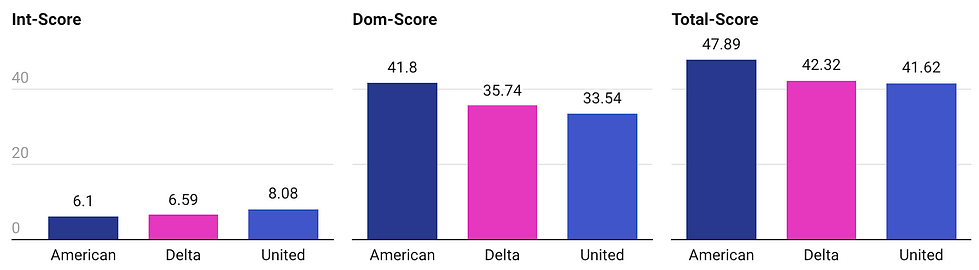
Although American Airlines, Delta Air Lines and United Airlines all operate extensive hub-and-spoke networks, each has adopted a distinct approach to balancing domestic and international connectivity (Figure X). The Connectivity Index scores closely reflect these strategic differences. American Airlines records the highest overall connectivity, driven by its extensive domestic network and a series of specialised international gateways. Delta Air Lines combines the industry's largest hub with a geographically balanced portfolio of international gateways that distribute connectivity more evenly across its network. In contrast, United Airlines places greater emphasis on international connectivity, as demonstrated by its highest international Connectivity Index score, supported by multiple globally focused hubs that provide the broadest and most geographically diversified international network among the three carriers. Overall, the findings highlight that network connectivity extends beyond airline size alone and is shaped by how carriers structure their hub networks, allocate capacity and prioritise access to international markets.
Figure 1. America's Big Three Airlines: Connectivity Index
Source: RDC Apex Created with Datawrapper